Pneumatic cylinders — commonly called air cylinders — are the workhorses of industrial automation. They convert compressed air into linear or rotary motion and power everything from packaging machines to robotic assembly lines. But not all air cylinders are the same. Choosing the wrong type can mean wasted energy, premature wear, or outright system failure.
This guide walks through every major type of air cylinder, how each one works, and where it belongs in a real-world system.
1. Single-Acting Cylinders
A single-acting cylinder uses compressed air to move the piston in one direction only. A spring (or sometimes gravity or an external load) returns the piston to its original position.
How it works: Air enters a single port, pushes the piston forward, and when pressure is released the spring pushes it back.
Best for:
- Clamping and holding operations
- Ejecting parts from molds or conveyors
- Applications where fail-safe retraction matters
Pros: Simple design, fewer seals, lower air consumption
Cons: Limited stroke length due to spring space, lower force output on the return stroke
2. Double-Acting Cylinders
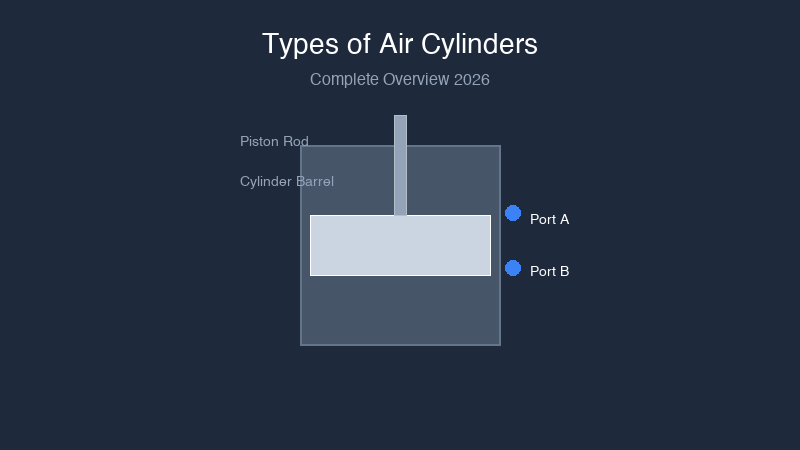
Double-acting cylinders are the most common type in industrial settings. Compressed air drives the piston in both directions — extend and retract — through two separate ports.
How it works: Air enters one port to extend the rod, and the opposite port to retract it. No spring needed.
Best for:
- Push-pull operations
- Conveyor diverters and gates
- Any application needing controlled motion in both directions
Pros: Equal force in both directions, longer strokes possible, precise control
Cons: Higher air consumption, requires directional control valves
3. Rodless Cylinders
Rodless cylinders eliminate the external piston rod entirely. Instead, the piston connects to an external carriage through a slot in the cylinder body, sealed by a magnetic or mechanical band.
How it works: The piston moves inside the barrel and carries the external load platform via a magnetic coupling or mechanical linkage through a sealed slot.
Best for:
- Long-stroke applications where a protruding rod would be impractical
- Space-constrained automation cells
- Material handling and pick-and-place systems
Pros: Same footprint as the stroke length (no rod overhang), high load capacity for size
Cons: More complex sealing, generally higher cost than rod-style cylinders
4. Compact Cylinders
Compact cylinders package the piston and guide rods into a short, space-saving body. They are designed for applications where mounting space is tight.
Best for:
- Fixture clamping in CNC machines
- Electronic assembly equipment
- Tight-spaced automation modules
Pros: Extremely short body length, often include guide rods for side-load resistance
Cons: Limited stroke lengths, lower force than full-size equivalents
5. Rotary Actuators (Rotary Cylinders)
Rather than linear motion, rotary actuators produce torque and angular rotation using pneumatic pressure. They come in rack-and-pinion and vane styles.
How it works: A rack-and-pinion design converts piston linear motion into shaft rotation. Vane types use a swinging vane inside a chamber.
Best for:
- Valve actuation (quarter-turn ball or butterfly valves)
- Part flipping or rotating on conveyors
- Robotic wrist joints
Pros: High torque in a compact package, simple pneumatic control
Cons: Limited rotation angle (typically 90°, 180°, or 270°)
6. Telescopic Cylinders
Telescopic cylinders use nested stages that extend sequentially, giving a long stroke from a short retracted length — like a radio antenna.
Best for:
- Dump truck beds and heavy equipment
- Vertical lift platforms
- Applications needing extreme stroke-to-retracted-length ratios
Pros: Very long strokes from a compact body
Cons: Staged force output (force decreases as smaller stages engage), more complex maintenance
7. Guided Cylinders
Guided cylinders integrate guide rods or a linear bearing system directly into the cylinder body. This resists side loads and rotation without needing external guides.
Best for:
- Stopping or lifting products on conveyors
- Press-fit assembly stations
- Applications with off-center loads
Pros: No need for external linear guides, high side-load resistance, anti-rotation
Cons: Larger footprint than standard cylinders, higher cost
8. ISO Standard Cylinders
ISO 15552 (formerly ISO 6431) and ISO 21287 define dimensional standards for pneumatic cylinders, ensuring interchangeability across manufacturers.
ISO 15552 (Round/profile tie-rod cylinders): The classic industrial cylinder — robust, repairable, available in bore sizes from 32mm to 320mm.
ISO 21287 (Compact standard): A shorter, standardized compact cylinder for space-saving designs.
Best for: Any application where you want drop-in interchangeability between brands
9. Stainless Steel Cylinders
Constructed with stainless steel bodies, rods, and hardware, these cylinders resist corrosion in harsh environments.
Best for:
- Food and beverage processing (washdown environments)
- Pharmaceutical manufacturing
- Marine and offshore applications
Pros: Excellent corrosion resistance, hygienic design options
Cons: Higher material cost, heavier than aluminum equivalents
10. Miniature / Micro Cylinders
Miniature cylinders have bore sizes typically under 12mm and are used where space and weight are at an absolute premium.
Best for:
- Laboratory automation
- Semiconductor handling
- Medical devices
Pros: Tiny footprint, lightweight
Cons: Very low force output, delicate construction
Quick Selection Table
| Cylinder Type | Typical Bore Range | Stroke Range | Best Use Case |
|---|---|---|---|
| Single-Acting | 6–100mm | Short | Clamping, ejecting |
| Double-Acting | 6–320mm | Short to long | General automation |
| Rodless | 16–80mm | Long | Space-saving long stroke |
| Compact | 12–125mm | Short | Tight-space mounting |
| Rotary | N/A (torque) | 90–270 deg | Valve actuation, part rotation |
| Telescopic | 50–200mm+ | Very long | Dump beds, lift platforms |
| Guided | 12–100mm | Short to medium | Side-loaded applications |
| Stainless Steel | 10–200mm | Short to long | Washdown, food-grade |
| Miniature | 2.5–16mm | Short | Lab, medical, semiconductor |
Which Air Cylinder Type Do You Need?
The decision boils down to four questions:
- Stroke length — Short or long? Rodless and telescopic solve long-stroke problems.
- Space constraints — Compact or guided cylinders save space; rodless cylinders save even more on long strokes.
- Environment — Corrosive or washdown? Go stainless steel.
- Side loading — If the load isn't perfectly axial, guided cylinders protect against premature seal wear.
At Air Cylinder Manufacturing, we produce double-acting, single-acting, compact, and custom pneumatic cylinders to match your exact specifications. Reach out to our engineering team for help selecting the right type — or designing one from scratch.
Need a custom air cylinder? Contact us for a quote or consult with our engineering team.
Explore our full range: Standard Air Cylinders | Compact Cylinders | Guided Cylinders | Rodless Cylinders | Specialty Cylinders