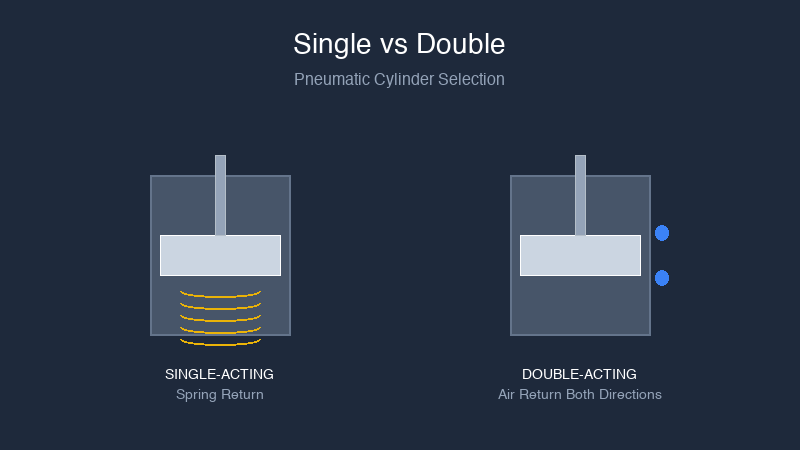
Pneumatic cylinder selection begins with a fundamental question: do you need powered force in both directions, or can one direction rely on a spring or external force? The answer to this question determines whether a single-acting or double-acting pneumatic cylinder is the right choice for your application. Making this decision correctly affects everything from energy consumption to control system complexity to initial component cost.
This guide explains the functional differences between single-acting and double-acting pneumatic cylinders, provides decision criteria that apply to real-world industrial applications, and helps you select the right configuration for your specific requirements.
How Single-Acting and Double-Acting Cylinders Work
Single-Acting Cylinder Operation
A single-acting cylinder has one air port. Compressed air enters the cylinder on one side of the piston, driving it in one direction—typically extension. When the air is exhausted, a internal spring returns the piston to its original position. Some single-acting designs use an external load or gravity for return instead of a spring.
Air flow sequence:
[Air in through port] → Piston extends (against spring or load)
[Air exhausted] → Spring or load returns piston
The spring inside a single-acting cylinder occupies space that would otherwise be available for stroke length. This design constraint limits practical stroke lengths to approximately 80 to 100mm. Beyond this range, the spring becomes impractically long relative to the cylinder’s total length.
Double-Acting Cylinder Operation
A double-acting cylinder has two air ports—one on each side of the piston. Compressed air drives the piston in both extension and retraction directions. No spring is required, which means there is no internal mechanism consuming space in the cylinder body.
Air flow sequence:
[Air in port A, exhaust from port B] → Piston extends
[Air in port B, exhaust from port A] → Piston retracts
The ability to control both extension and retraction independently enables precise speed control in both directions—a significant advantage in applications requiring controlled approach and departure speeds.
Head-to-Head Comparison: Single vs Double Acting
| Factor | Single-Acting | Double-Acting |
|---|---|---|
| Number of ports | 1 | 2 |
| Control valve required | 3/2-way valve (simpler, less expensive) | 4/2-way or 5/2-way valve |
| Powered directions | One (extension only) | Both (extension and retraction) |
| Return mechanism | Internal spring or external load/gravity | Compressed air (full force available) |
| Extend force | Full pneumatic force | Full pneumatic force |
| Retract force | Spring force only (typically 5-15% of extend) | Full pneumatic force (minus rod area) |
| Maximum stroke | Approximately 80-100mm (spring limits) | Several meters (no spring constraint) |
| Air consumption | Lower (air used one direction only) | Higher (air used both directions) |
| Fail-safe behavior | Spring returns to home position on air loss | Stays in last position (no spring backup) |
| Speed control | Extend stroke only (return speed set by spring) | Both strokes independently controllable |
| Component cost | Lower (simpler construction) | Moderate (additional port, seals, valve) |
| Energy efficiency | Higher (no air consumption on return) | Lower (continuous air use) |
When to Choose Single-Acting Cylinders
Single-acting cylinders excel in applications with specific characteristics. The decision to use a single-acting cylinder should be based on application requirements rather than cost considerations alone—using a single-acting cylinder where a double-acting cylinder is required leads to equipment failure and production downtime.
Ideal Applications for Single-Acting Cylinders
- Clamping fixtures: Spring holds the clamp closed; air releases it. When air pressure drops, the spring clamps automatically—critical for safety.
- Part ejection from dies and molds: Pneumatic push ejects the part; spring returns the actuator for the next cycle.
- Conveyor stops and diverters: Spring-up stops that lower when air is applied; gravity returns them when air releases.
- Braking systems: Spring-applied, air-released brakes provide fail-safe holding—air pressure releases the brake, spring applies it when air is lost.
- Holding and locating pins: Pin extends to locate a component; spring holds it in position until air retracts.
- Light-duty sorting gates: Simple push or pull motion with automatic return between cycles.
Advantages of Single-Acting Cylinders
Fail-safe operation: When air pressure is lost, the spring returns the cylinder to a predetermined home position. This is essential for clamping and braking applications where an uncontrolled release could create a safety hazard or damage equipment.
Lower air consumption: Because air is used only for extension, a single-acting cylinder consumes approximately half the compressed air of an equivalent double-acting cylinder in typical cycling applications. In facilities with dozens or hundreds of cylinders, this translates to measurable energy savings.
Simpler control logic: A 3/2-way valve is less expensive and easier to wire than a 4/2 or 5/2 valve. Fewer valves means fewer potential failure points and simpler troubleshooting.
Lower component cost: Single-acting cylinders are less expensive than double-acting models of the same bore and stroke due to simpler construction—fewer machined ports, simpler piston seal geometry, no need for rod seals on the retract side.
Limitations of Single-Acting Cylinders
Stroke limitation: The internal spring requires space that increases with stroke length. Most single-acting cylinders cap practical stroke at approximately 80 to 100mm. Applications requiring longer strokes must use double-acting cylinders.
Low retract force: Spring return force is typically only 5 to 15% of the cylinder’s extend force. If the application requires significant retraction force—pulling a load back against resistance, for example—single-acting cylinders cannot provide it.
Spring fatigue: Over millions of cycles, the return spring weakens and may eventually fail. High-cycle applications require cylinders with replaceable spring cartridges or consideration of double-acting alternatives.
Single-direction speed control: Only the extend stroke can be meterd with flow control valves. The return speed is determined by the spring rate and load, which cannot be adjusted remotely.
When to Choose Double-Acting Cylinders
Double-acting cylinders are the default choice for most industrial automation applications. When the application requires force in both directions, precise control of retract speed, or strokes exceeding 100mm, the double-acting configuration is the correct selection.
Ideal Applications for Double-Acting Cylinders
- Push-pull operations: Diverters, gates, and transfer mechanisms that need powered force in both directions.
- Lifting and lowering with controlled descent: Applications where the downward speed must be controlled precisely, not just determined by load and spring rate.
- Pressing and assembly operations: Force is required both to advance the press and to retract after the press cycle.
- Long-stroke applications: Any application requiring more than 100mm of stroke—double-acting cylinders can achieve strokes of several meters in rodless configurations.
- High-speed cycling: Applications where cycle rates exceed what a spring-return mechanism can achieve reliably.
- Bidirectional force requirements: Any application where the load must be pushed and pulled with equivalent force capability.
Advantages of Double-Acting Cylinders
Full force in both directions: Both extension and retraction provide the full pneumatic force output calculated from pressure and piston area. There is no limitation from spring force on the return stroke.
Independent speed control: Flow control valves on both ports enable independent adjustment of extend and retract speeds. This is critical for applications requiring controlled approach to a work piece or governed retract speed.
No stroke limitation: Without an internal spring, double-acting cylinder length is determined only by the required stroke and bearing requirements. Rodless double-acting cylinders can achieve strokes of several meters.
Consistent cycle characteristics: There is no spring to fatigue, weaken, or wear out. Double-acting cylinders maintain consistent extend and retract speeds over millions of cycles.
Limitations of Double-Acting Cylinders
Higher air consumption: Both extension and retraction use compressed air. In high-cycle applications, this increases energy costs compared to single-acting alternatives.
No inherent fail-safe: When air pressure is lost, the cylinder stops wherever it is mid-stroke. For fail-safe applications, a spring-return valve or external brake must be added.
More complex valving: A 4/2 or 5/2 valve is required, increasing component cost and control complexity compared to single-acting 3/2 valves.
Decision Flowchart: Single vs Double Acting
Use this decision sequence to select the correct cylinder type:
Does your application require powered force in BOTH directions?
├── YES → Double-Acting (your application needs it)
└── NO  → Continue ↓

Is the required stroke longer than approximately 100mm?
├── YES → Double-Acting (spring impractical at long strokes)
└── NO  → Continue ↓

Does your application require fail-safe return when air pressure is lost?
├── YES → Single-Acting (spring provides automatic fail-safe return)
└── NO  → Continue ↓

Is air consumption a significant operating cost concern in your facility?
├── YES → Single-Acting (approximately 50% less air consumption per cycle)
└── NO  → Either configuration works
         → Single-Acting is simpler and less expensive
         → Use Single-Acting if your mechanism accommodates the return force limitation
Air Consumption Comparison
For a 50mm bore, 100mm stroke cylinder operating at 6 bar with one cycle per minute:
| Cylinder Type | Air per Cycle (liters) | Annual Air Cost Estimate* |
|---|---|---|
| Single-Acting | Approximately 0.15 liters | $120-$180 per year |
| Double-Acting | Approximately 0.28 liters | $230-$350 per year |
*Based on $0.05 per kWh for compressed air generation, 8-hour shifts, 250 working days per year. Actual costs vary with facility efficiency, cycle rate, and energy pricing.
In a facility operating 200 cylinders at high cycle rates, switching to single-acting where applications permit can save $20,000 to $40,000 per year in compressed air costs alone.
The Third Option: Double-Acting with External Spring
Some applications benefit from a hybrid approach: a double-acting cylinder with an external spring or counterweight for return. This configuration provides full pneumatic force during extension, while the external spring provides fail-safe return when air pressure is lost. Common in vertical lift applications where gravity assists retraction but a spring provides additional fail-safe capacity.
Frequently Asked Questions
Can a single-acting cylinder be converted to double-acting?
No. The internal spring mechanism is a structural component of the single-acting cylinder design. Attempting to convert a single-acting cylinder to double-acting by applying air to the spring side would damage the spring and potentially cause mechanical failure.
Why is double-acting retract force lower than extend force?
The piston rod occupies space on one side of the piston, reducing the effective area on that side. The retract force equals extend force minus the force that the rod cross-sectional area can generate at the same pressure. For a 50mm bore cylinder with a 20mm diameter rod, the retract force is approximately 20% lower than extend force.
What happens if a single-acting cylinder spring breaks?
A broken spring results in loss of return force. The cylinder would no longer return to its home position when air is exhausted. In clamping applications, this could create a safety hazard. In ejection applications, the mechanism would not reset for the next cycle. Spring replacement is required—this is why high-cycle applications should specify cylinders with replaceable spring cartridges.
Which cylinder type has a longer service life?
Double-acting cylinders typically have longer service lives in high-cycle applications because there is no spring component subject to fatigue failure. However, single-acting cylinders in appropriate applications—with strokes under 80mm and moderate cycle rates—often outlast double-acting cylinders because they have simpler seal geometry with fewer potential leak paths.
Conclusion
Choosing between single-acting and double-acting pneumatic cylinders is a fundamental decision that affects equipment cost, operating efficiency, and system reliability. The decision should be driven by application requirements—not by the lower price of single-acting cylinders.
Use the criteria in this guide to make the selection with confidence. When in doubt, consult with a pneumatic component engineer who can review your specific application requirements and recommend the optimal configuration.
Our engineering team provides free application consultation to help you select the correct cylinder type and configuration for your specific requirements. We stock both single-acting and double-acting cylinders in all standard bore sizes and stroke lengths, with same-day shipping available for in-stock models.
Get Application Selection Help | View Single-Acting Cylinders | View Double-Acting Cylinders