It is the most fundamental choice in pneumatic cylinder selection: one port or two? Spring return or powered return? The answer isn't just about complexity — it affects force, speed, air consumption, and what happens when the air supply fails.
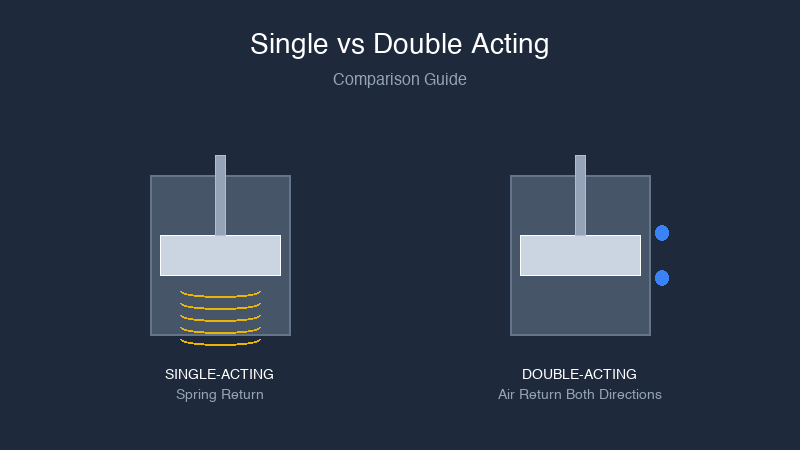
Here is the comparison that helps you choose with confidence.
How They Work
Single-Acting Cylinder
A single-acting cylinders has one air port. Compressed air pushes the piston in one direction (usually extend). A spring — built into the cylinder — pushes it back when the air is exhausted.
[Air in] → Piston extends (against spring)
[Air out] → Spring retracts piston
Double-Acting Cylinder
A double-acting cylinders has two air ports — one on each side of the piston. Compressed air drives the piston in both directions. No spring.
[Air in port A, Air out port B] → Piston extends
[Air in port B, Air out port A] → Piston retracts
Head-to-Head Comparison
| Factor | Single-Acting | Double-Acting |
|---|---|---|
| Number of ports | 1 | 2 |
| Valve required | 3/2-way (3 port, 2 position) | 5/2-way or 4/2-way (5 port, 2 pos) |
| Powered directions | One | Both |
| Return mechanism | Spring (or external load/gravity) | Compressed air |
| Force — extend | Full pneumatic force | Full pneumatic force |
| Force — retract | Spring force only (much lower) | Full pneumatic force (minus rod area) |
| Maximum practical stroke | ~100mm (spring space limits) | Several meters |
| Air consumption | Lower (no air used for return) | Higher (air used on both strokes) |
| Fail-safe behavior | Spring returns to home position | Stays in last position (unless valve shifts) |
| Speed control | Extend stroke only | Both strokes independently |
| Cost | Lower | Moderate |
When to Choose Single-Acting
Single-acting cylinders shine in applications that need one thing: a simple push, clamp, or eject — with automatic return.
Ideal applications:
- Clamping fixtures (spring holds; air releases)
- Part ejection from dies or molds
- Conveyor stops (spring-up stops that lower with air)
- Braking systems (spring-applied, air-released = fail-safe braking)
- Holding and locating pins
- Light-duty sorting gates
Advantages:
-
Fail-safe behavior. If air pressure drops, the spring returns the cylinder to a known position. Critical for safety applications like brakes and clamps.
-
Lower air consumption. Since air is not used on the return stroke, a single-acting cylinder uses roughly half the air of an equivalent double-acting one. In a plant with hundreds of cylinders, this adds up.
-
Simpler control. A 3/2 valve is cheaper and simpler than a 5/2 or 4/2 valve. Fewer tubes, fewer fittings.
-
Lower cost. One fewer port to machine, no complex piston seals for bidirectional sealing.
Limitations:
-
Stroke is limited by spring length. Most single-acting cylinders cap out around 80–100mm. Beyond that, the spring becomes impractically long.
-
Return force is low. Spring force is typically 5–15% of the pneumatic extend force. If the return stroke needs significant force — pulling a load back, for example — single-acting won't work.
-
Spring fatigue. Over millions of cycles, springs can weaken or break. In high-cycle applications, specify a cylinder with a replaceable spring cartridge.
-
Speed only controllable on one stroke. You can meter the extend speed, but the return speed is determined by the spring rate and load.
When to Choose Double-Acting
Double-acting cylinders are the default for most industrial automation. If you need power and control in both directions, this is the answer.
Ideal applications:
- Push-pull operations (diverters, gates, transfer mechanisms)
- Lifting and lowering with controlled descent
- Pressing and assembly operations
- Any application needing equal force in both directions
- Long-stroke applications (>100mm)
- High-speed cycling where spring return would be too slow
Advantages:
-
Full force in both directions. The cylinder can push and pull with pneumatic force — not just a spring.
-
Long strokes. No spring to accommodate. Rodless double-acting cylinders can stroke several meters.
-
Independent speed control on both strokes. Flow control valves meter extend and retract speeds independently.
-
Consistent cycle characteristics. No spring fatigue or variation in return speed over the cylinder's service life.
Limitations:
-
Higher air consumption. Both strokes use compressed air.
-
No inherent fail-safe position. If air pressure fails with the cylinder mid-stroke, it stays there (or drifts). For fail-safe applications, add a spring-return valve or external brake.
-
More complex valving. A 5/2 or 5/3 valve is required, and both ports need tubing and flow controls.
Air Consumption Comparison
For a 50mm bore, 100mm stroke cylinder at 6 bar, cycling once per second:
| Type | Air per Cycle (Nl) | Air per 8-Hour Shift (Nl) |
|---|---|---|
| Single-acting (extend only) | ~0.15 | ~4,320 |
| Double-acting | ~0.28 | ~8,064 |
The difference is roughly 2×. In a factory with 200 cylinders, switching from double-acting to single-acting where appropriate could save tens of thousands of dollars per year in compressed air costs.
Decision Flowchart
Do you need powered force in BOTH directions?
├── YES → Double-Acting
└── NO  → Continue ↓

Is the stroke longer than ~100mm?
├── YES → Double-Acting (spring impractical)
└── NO  → Continue ↓

Is fail-safe return required on air loss?
├── YES → Single-Acting (spring return)
└── NO  → Continue ↓

Is air consumption a significant cost concern?
├── YES → Single-Acting
└── NO  → Either works — single-acting is simpler and cheaper
The Third Option: Double-Acting with External Spring
Some applications use a double-acting cylinder with an external spring or counterweight for return. This preserves full pneumatic force in both directions when needed, while providing some fail-safe behavior. Common in vertical lifts where gravity assists retraction.
Bottom Line
For most general automation — clamping, ejecting, holding, light pressing — a single-acting cylinder is the simpler, cheaper, and more energy-efficient choice, provided the stroke is short and you only need power in one direction.
For everything else — long strokes, bidirectional force, controlled return speed — the double-acting cylinder is the right tool.
At Air Cylinder Manufacturing, we produce both single-acting and double-acting cylinders in a wide range of bore sizes, strokes, and mounting configurations. Not sure which one you need? Tell us what you're building and we'll help you decide.
Get a recommendation from our engineers.
Explore both types: Linear Air Cylinders | Standard Double-Acting Cylinders