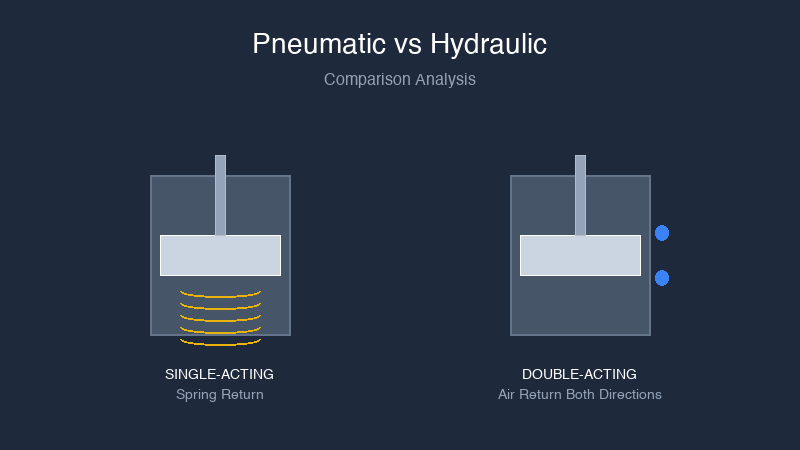
Choosing between pneumatic and hydraulic cylinders is one of the foundational decisions in industrial equipment design. The choice affects everything from the cost of the actuator itself to the complexity of the power system, from operating energy costs to maintenance requirements. Making this decision correctly requires understanding the fundamental physical principles that distinguish these two technologies—and how those differences translate to practical performance in real applications.
This guide provides a systematic comparison of pneumatic and hydraulic actuation, with decision criteria that help engineers, maintenance managers, and procurement specialists select the right technology for their specific requirements.
Understanding the Fundamentals: Why These Technologies Differ
Pneumatic systems and hydraulic systems both transmit force through fluid pressure—but the physical properties of the fluids they use create dramatically different performance characteristics.
Compressed air is compressible. This fundamental property means that when you apply pressure to air, it compresses significantly before building resistance. The result is a system that is easy to operate, tolerant of overloads, and inherently safe—but one that provides less precise control and generates more heat during high-force operations.
Hydraulic fluid is nearly incompressible. This means force is transmitted instantly through the system, with precise control and high power density—but at the cost of higher complexity, greater safety hazards from high-pressure fluid, and more expensive components.
Head-to-Head Comparison: Pneumatic vs Hydraulic
| Factor | Pneumatic | Hydraulic |
|---|---|---|
| Power density | Low to moderate (up to ~1,000 PSI / 70 bar) | High (up to 5,000 PSI / 350 bar) |
| Force capability | Up to ~50,000N for standard cylinders | Up to 500,000N+ for large hydraulic cylinders |
| Control precision | Moderate (position control ±0.5mm typical) | High (position control ±0.05mm or better) |
| Speed control | Good (flow control valves on both ports) | Excellent (precise flow control) |
| Energy efficiency | Lower (compression losses) | Higher (incompressible fluid) |
| System complexity | Simple (compressor, dryer, piping, valve) | Complex (pump, reservoir, filters, coolers, valves) |
| Maintenance requirements | Low (no fluid contamination concerns) | Higher (fluid quality critical) |
| Leak consequences | Minor (air leak, no contamination) | Significant (fluid leak, environmental hazard) |
| Operating cost | Moderate (air generation is energy-intensive) | Lower (energy per unit of work) |
| Safety | Safe (low pressure, air is non-toxic) | Hazardous (high pressure, fluid injection risk) |
| Availability | Widely available (every factory has compressed air) | Requires dedicated hydraulic system |
When to Choose Pneumatic Cylinders
Pneumatic actuation is the correct choice when the application requirements favor simplicity, safety, and widespread availability over extreme force and precision.
Ideal Applications for Pneumatic Cylinders
- Factory automation: Most automated equipment already has compressed air infrastructure, making pneumatic actuation the lowest-cost option for new equipment.
- Packaging machinery: High-speed, repetitive motion where absolute positioning precision is less critical than consistent cycle timing.
- Material handling: Conveyors, diverters, stop gates, and accumulation systems where forces are moderate and reliability is critical.
- Food and pharmaceutical: Applications requiring washdown and cleanroom compatibility where hydraulic fluid leakage creates regulatory risk.
- Small to medium force requirements: Applications requiring less than 50,000N of force—the practical upper limit of standard pneumatic cylinders.
- High-cycle applications: Applications exceeding 60 cycles per minute where hydraulic system response may be insufficient.
- Hazardous environments: Areas where hydraulic fluid leakage creates fire hazard or where the energy density of hydraulics is excessive for the task.
Advantages of Pneumatic Systems
Simplicity: A pneumatic system requires only a compressor, air preparation (filtration, drying, lubrication), piping, and a directional control valve. This system is already present in most manufacturing facilities, eliminating the need for dedicated power infrastructure.
Safety: Pneumatic systems operate at much lower pressures than hydraulic systems, and air leakage is harmless rather than hazardous. There is no risk of fluid injection injuries or environmental contamination from hydraulic leaks.
Cost: Pneumatic cylinders cost 30 to 50% less than equivalent hydraulic cylinders. The supporting infrastructure—compressors, dryers, piping—is already amortized across the facility’s existing pneumatic tools and equipment.
Speed: Pneumatic actuators respond faster than hydraulic actuators because the compressible air does not have the inertial resistance of hydraulic fluid in the lines. For high-speed packaging and assembly applications, this response time advantage is significant.
When to Choose Hydraulic Cylinders
Hydraulic actuation is the correct choice when the application demands forces that exceed the practical limits of pneumatics, or when the precision and control capability of hydraulics is required for the task.
Ideal Applications for Hydraulic Cylinders
- Heavy press operations: Metal stamping, forging, and forming operations requiring forces exceeding 100,000N—well beyond the capability of standard pneumatic cylinders.
- Large machine tools: CNC machining centers and large presses where hydraulic clamping and actuation provides the stiff, precise force transmission required for heavy cutting operations.
- Aerospace manufacturing: Large-scale composite layup and drilling operations where hydraulic actuation provides the force and precision required.
- Mining and heavy equipment: Excavators, loaders, and Crushers where hydraulic systems provide the power density needed for mobile equipment.
- Precision force control: Applications requiring precise force regulation (hydraulic systems can hold force precisely due to non-compressible fluid) such as testing and calibration equipment.
Advantages of Hydraulic Systems
Power density: Hydraulic systems operate at pressures 5 to 10 times higher than pneumatic systems, providing proportional force and torque capability from smaller, lighter components.
Precision: The incompressible nature of hydraulic fluid enables precise position and force control that pneumatic systems cannot match. Servo-hydraulic systems achieve positioning accuracy of ±0.01mm in demanding applications.
Force holding: Hydraulic cylinders hold position and force precisely because the incompressible fluid does not “give” like compressed air. This makes hydraulics ideal for clamping and fixturing applications where position must be maintained.
Energy efficiency: For high-force applications, hydraulic systems use less energy than equivalent pneumatic systems because the incompressible fluid does not waste energy through compression and decompression cycles.
Cost Comparison: Total Cost of Ownership
Initial component cost comparison favors pneumatics—but total cost of ownership reveals a more nuanced picture for high-force applications.
| Cost Category | Pneumatic | Hydraulic |
|---|---|---|
| Actuator cost | $200-2,000 (standard cylinders) | $500-8,000 (standard cylinders) |
| Power system infrastructure | $0 (use existing compressed air) | $15,000-50,000 (new system) |
| Installation complexity | Simple piping, low cost | Complex, high labor cost |
| Operating energy cost | Higher (air compression is energy-intensive) | Lower (pump efficiency) |
| Maintenance cost | Low (no fluid to manage) | Higher (fluid changes, filter replacement) |
| Downtime cost (leaks) | Low (air leak, quick repair) | High (fluid contamination, clean-up) |
| 5-year total cost (moderate use) | $800-3,000 | $8,000-25,000 |
| 5-year total cost (heavy use, high force) | Not applicable (>50,000N) | $15,000-40,000 |
Hybrid Solutions: Pneumatic and Hydraulic Combined
Some applications benefit from combining pneumatic and hydraulic technologies in the same system—using pneumatics for high-speed, low-force motions and hydraulics for high-force positioning.
- Machine tool quick-return: Pneumatic return stroke for fast tool retraction, hydraulic advance for controlled cutting feed.
- Stamping press: Pneumatic blank holding, hydraulic forming.
- Large robot end-effectors: Pneumatic grippers for fast pick-and-place, hydraulic force for slow, powerful pressing operations.
Decision Framework
Use this decision sequence to select the correct actuation technology:
Does your application require more than 50,000N of force?
├── YES → Hydraulic (pneumatic cylinders cannot provide this)
└── NO  → Continue ↓

Is precise position or force control required (±0.1mm or better)?
├── YES → Hydraulic (pneumatic precision is ±0.5mm typical)
└── NO  → Continue ↓

Does your facility already have compressed air infrastructure?
├── YES → Pneumatic (use existing infrastructure)
└── NO  → Continue ↓

Is high-speed cycling (over 60 cycles/minute) required?
├── YES → Pneumatic (hydraulic response is insufficient)
└── NO  → Continue ↓

Is safety a primary concern (fluid leakage hazard)?
├── YES → Pneumatic (no hazardous fluid)
└── NO  → Evaluate both based on other criteria
Frequently Asked Questions
Can I replace a hydraulic cylinder with a pneumatic cylinder in my existing equipment?
Generally no—hydraulic systems and pneumatic systems have fundamentally different infrastructure requirements. A hydraulic system operates at 2,000 to 5,000 PSI, while pneumatic systems typically operate at 80 to 150 PSI. The cylinder itself may be physically similar, but the valves, piping, and power system are completely different.
What happens if I oversize a pneumatic cylinder?
Oversizing a pneumatic cylinder wastes energy by consuming more compressed air than necessary for the task. It also increases air consumption and may exceed the capacity of your existing compressor. Larger cylinders also cost more and may require larger valves and piping to supply the required airflow.
Why do hydraulic systems require more maintenance than pneumatic systems?
Hydraulic fluid is sensitive to contamination from particles, water, and thermal degradation. Maintaining fluid cleanliness requires regular filter changes, fluid analysis, and periodic fluid replacement. Pneumatic systems do not have these requirements—contaminants in compressed air are filtered out at the point of use, and the air itself does not degrade over time.
Conclusion
The choice between pneumatic and hydraulic actuation shapes the cost, performance, and reliability of your equipment for its entire service life. For most factory automation applications with forces below 50,000N, pneumatic actuation delivers the best balance of cost, simplicity, and reliability. For heavy-duty applications requiring extreme force or precision positioning, hydraulic actuation is the only practical choice.
Our engineering team helps customers evaluate actuation technology options for their specific applications. We stock both pneumatic and hydraulic cylinders in standard sizes, and provide custom configurations for specialized requirements. Contact us for an application consultation to determine the optimal technology for your equipment.
Get Actuation Technology Recommendation | Browse Pneumatic Cylinders | View All Cylinder Products