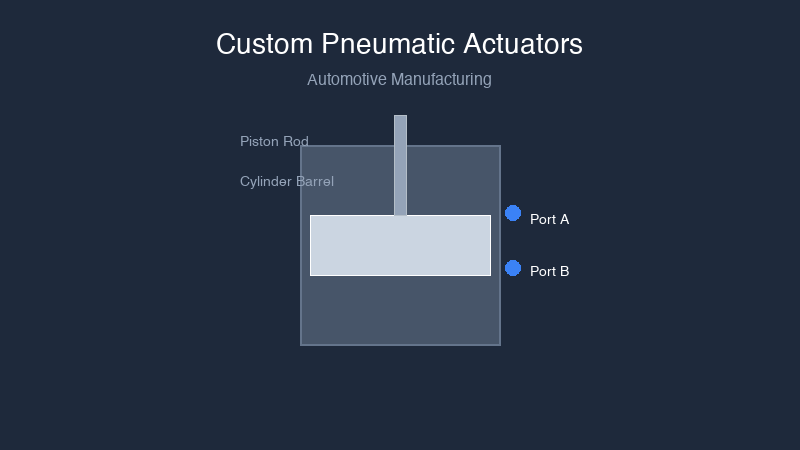
The automotive manufacturing industry operates at tolerances measured in millimeters and production targets measured in vehicles per hour. Every actuator, every sensor, and every pneumatic cylinder must perform precisely within this system—or the entire line stops. Custom pneumatic actuators have become essential components in modern automotive assembly because standard off-the-shelf products cannot meet the specific demands of today’s vehicle manufacturing platforms.
From robotic welding cells to automated guided vehicles, from door panel installation to engine block handling, custom actuators solve problems that standardized components cannot address: non-standard stroke lengths, unique mounting configurations, integrated sensors, or operation in extreme temperature zones adjacent to welding equipment.
Why Standard Pneumatic Actuators Fall Short in Automotive Manufacturing
Modern automotive assembly lines are not designed around components—they are designed around process requirements. An engineer determines the exact movement profile needed: 340mm of travel in 1.2 seconds, with a holding force of 2,400N at mid-stroke, and a specific pivot point 85mm off the main structural rail. When this specification is handed to a component engineer, the standard product catalog rarely contains a cylinder that meets all three criteria simultaneously.
Standard ISO 15552 cylinders come in fixed bore sizes, standard stroke increments, and defined mounting patterns. When the application requires something outside these parameters—say, a 347mm stroke in a 40mm bore with a rear clevis mount and an integrated position sensor—the engineer faces a choice: compromise the design around available components, or specify a custom solution.
Compromising the design introduces risk. A cylinder with 10% more stroke than needed creates positioning uncertainty. A bore size one step up from optimal adds cost and air consumption without corresponding benefit. A mounting style chosen for availability rather than fit creates alignment problems that accelerate wear and reduce service life.
Custom actuators eliminate these compromises. Working directly with a manufacturer that can produce non-standard bore and stroke combinations, modify mounting configurations, and integrate sensors or valves during assembly delivers a component that fits the application exactly—rather than forcing the application to fit the component.
Key Customizations for Automotive Applications
Non-Standard Stroke Lengths
Automotive assembly robots and transfer systems frequently require stroke lengths that fall between the standard 25mm increments of catalog products. A door hinge installation actuator might need exactly 287mm of travel to move from the pick-up position to the installation point—a stroke that falls between standard offerings. A custom manufacturer produces the exact stroke needed, eliminating the dead space that standard increments introduce into the machine envelope.
Integrated Position Sensors
Industry 4.0 manufacturing demands real-time position feedback from every actuator in the system. A custom pneumatic actuator with an integrated linear position sensor delivers continuous stroke position data to the control system without the added bulk and mounting complexity of an external sensor clamp. This integration reduces wiring complexity, improves reliability, and simplifies the PLC programming required to manage the motion sequence.
High-Temperature Environments
Adjacent to resistance welding equipment, automotive paint shops, and engine assembly test cells, ambient temperatures routinely exceed the rating of standard seal compounds. Custom actuators specify high-temperature seal materials—Viton, Aflas, or EPDM depending on the chemical exposure profile—that survive these environments without accelerated degradation. Standard Buna-N seals in the same application fail within weeks.
Compact Integration
As automotive assembly lines consolidate to reduce factory floor footprint, actuator mounting envelopes shrink correspondingly. Custom actuators designed for specific machine builders eliminate the excess material and mounting flange overhead that standardized products carry. A tailor-made actuator for a tight integration pocket reduces the overall machine dimension by 40 to 60mm—a significant gain when multiple actuators occupy a single work cell.
The Custom Actuator Development Process
A professional custom actuator manufacturer follows a structured development process that protects the automotive OEM from specification errors and delivery surprises.
Application Engineering Review: The manufacturer’s engineering team reviews the movement specification, environmental conditions, and integration requirements before presenting a proposed solution. This review catches dimensional conflicts, identifies seal material incompatibilities, and verifies that the proposed actuator can be produced reliably at the required volume.
Prototype and Testing: Before full production begins, a prototype actuator undergoes functional testing in the customer’s application environment. This testing phase—typically 4 to 8 weeks depending on complexity—validates that the actuator performs as specified across the full range of operating conditions, including cold-start scenarios, maximum load conditions, and accelerated cycle testing.
Production Qualification: Once prototype testing is complete, the production process undergoes qualification. The manufacturer demonstrates that the production line can produce actuators meeting the same specifications as the prototype, with consistent quality across thousands of units. This step includes first-article inspection reports, CMM verification of critical dimensions, and pressure testing documentation.
Volume Production: With engineering validation and production qualification complete, volume delivery begins. A professional custom actuator partner maintains safety stock of key components, provides dedicated production slots for automotive customers, and offers expedited lead times for replacement orders when unexpected demand occurs.
Quality Standards and Certifications for Automotive Pneumatic Actuators
Automotive customers operate under strict quality management systems that require documented traceability from raw material to finished actuator. Your custom actuator manufacturer should maintain:
- ISO 9001:2015 certification with current audit records from an IAF-accredited registrar
- IATF 16949 compliance for automotive industry quality management systems
- PPAP documentation capability for Production Part Approval Process submissions
- Material traceability with mill certificates for aluminum bar stock, chrome-plated rod, and seal compounds
Without these systems in place, the automotive OEM risks quality escapes that trigger customer complaints, costly field repairs, and potential reputational damage to the vehicle brand.
Cost Considerations in Custom Automotive Actuators
Custom actuators cost more upfront than standard catalog products—but the total cost of ownership often tells a different story. When a standard cylinder requires modification in the field—additional brackets, extended pilot lines, external sensors—the added component cost and installation time frequently exceed the premium paid for a custom solution specified correctly from the start.
Beyond direct component cost, custom actuators reduce engineering revision cycles by eliminating the iteration loop where the design team modifies the application to fit available components. A direct specification of the exact stroke, force, and mounting configuration removes this iteration cost from the project timeline entirely.
Volume plays a significant role in the economics of custom actuators. As order quantities increase, the per-unit cost of custom manufacturing approaches standard product pricing. Automotive programs with annual volumes exceeding 5,000 units per actuator model typically see custom actuator pricing within 15 to 25% of equivalent standard catalog products—well within the total-cost-of-ownership advantage.
Frequently Asked Questions
What is the typical lead time for custom automotive pneumatic actuators?
Lead times vary by complexity. Simple modifications to standard products—non-standard stroke, alternative mounting—typically require 4 to 6 weeks. Complex custom designs with integrated sensors, special seals, or non-standard bore sizes may require 8 to 12 weeks for prototype and production qualification. Automotive customers with long-term programs often negotiate consignment stock arrangements that provide 4 to 8 weeks of on-site inventory, eliminating emergency order lead times for routine replenishment.
Can custom actuators be designed to fit existing mounting patterns?
Yes. One of the most common custom actuator specifications is a non-standard bore and stroke combined with an existing ISO 15552 or NFPA mounting pattern. This approach preserves the existing machine design while delivering the exact force and travel the application requires. A qualified manufacturer can produce actuators with customer-specified mounting patterns that drop into existing equipment without machine modification.
What seal materials are available for high-temperature automotive environments?
Standard seals use NBR (Buna-N) compounds rated to approximately 80°C. For higher temperatures, Viton fluoroelastomer handles up to 200°C, Aflas tetrafluoroethylene handles up to 230°C, and EPDM is suitable for applications involving brake fluid or steam. The correct material depends on the specific environmental profile—including temperature, chemical exposure, and cycle rate—that the actuator will experience in service.
Conclusion
Custom pneumatic actuators solve real engineering problems in automotive manufacturing. When standard products force design compromises, a properly specified custom actuator delivers exact force, precise stroke, and optimized mounting—without the alignment problems, air consumption penalties, and service life reduction that come from forcing an application into an ill-fitting component.
Our engineering team specializes in custom actuator design for automotive applications. We maintain IATF 16949-compliant quality systems and offer PPAP documentation support for customer approval processes. Share your movement specification and we will deliver a validated actuator solution within your program timeline.
Discuss Your Custom Actuator Requirements | View Custom OEM Solutions | Browse Product Catalog