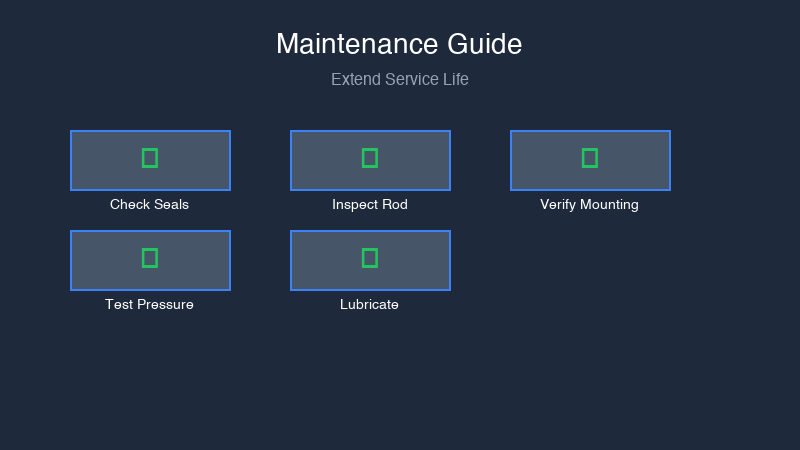
Air cylinder maintenance is the most effective way to extend equipment service life and reduce unexpected downtime in pneumatic systems. A well-maintained pneumatic cylinder can deliver 5 to 10 million cycles before requiring seal replacement. A neglected cylinder in the same application might fail within 500,000 cycles—leaving your operations team scrambling for emergency repairs and replacement parts while production lines stand still.
Most air cylinder failures are not sudden. They begin with small warning signs: a slight drift in positioning, a minor leak audible only during quiet shifts, or a gradual loss of speed that operators attribute to air supply issues. Ignoring these signals accelerates wear on seals, piston rods, and bearings, turning manageable repairs into emergency replacements. This guide provides the maintenance knowledge your team needs to prevent these failures before they occur.
Why Air Cylinder Maintenance Gets Neglected
In most industrial facilities, pneumatic cylinders are installed and forgotten. They operate quietly in the background of automated equipment, cycling millions of times without attention—until something breaks. Maintenance teams are often stretched thin, and the complexity of diagnosing pneumatic issues makes preventive maintenance easy to defer.
Yet air cylinder failure is rarely sudden. It typically begins with small warning signs: a slight drift in positioning, a minor leak audible only during quiet shifts, or a gradual loss of speed that operators attribute to air supply issues. Ignoring these signals accelerates wear on seals, piston rods, and bearings, turning manageable repairs into emergency replacements.
The cost of reactive maintenance is always higher than proactive care. A single unplanned production stoppage in an automotive plant costs an average of $22,000 per hour. Investing two hours per month in preventive checks can eliminate the majority of these failures.
Understanding Air Cylinder Failure Modes
Effective maintenance requires understanding why cylinders fail. The primary failure modes are:
Seal Wear and Leakage
Seal wear is the leading cause of air cylinder failure. As seals degrade, air bypasses the piston or piston rod, causing pressure loss, reduced force output, and visible leakage. Seal wear accelerates from contamination, inadequate lubrication, high temperature, and side loading.
Piston Rod Surface Damage
The chrome-plated surface of the piston rod protects the internal chamber from contamination. When this surface is scratched, pitted, or worn, contaminants reach the seals, accelerating their degradation. Rod surface damage comes from contamination entering during operation, improper handling during maintenance, and misalignment causing side loading.
Internal corrosion
Moisture in compressed air causes internal corrosion on bare aluminum surfaces, steel components, and seal backings. This corrosion produces particles that contaminate the seal environment and degrade surfaces that should remain smooth.
Bearing and Guide Wear
The piston rod bearing and cylinder bore guide experience wear from side loading, contamination, and extended service time. This wear manifests as play or drift in positioning—particularly noticeable in applications requiring precise positioning.
Essential Maintenance Procedures
1. Air Supply Quality Management
Contaminants and moisture are the leading causes of premature air cylinder failure. Compressed air from the facility compressor carries oil residue, water vapor, dust, and pipe scale—all of which accelerate seal wear and cause internal corrosion. Installing point-of-use filters and air dryers directly upstream of each cylinder prevents contaminants from reaching the sealed chambers.
Check filter elements monthly and replace according to manufacturer schedule—typically every 3 to 6 months depending on the operating environment. In humid or dusty conditions, inspect filters more frequently.
2. Lubrication Verification
While many modern cylinders are marketed as “lube-free,” this designation applies only to the internal piston seals and bearings. The pilot valves, flow controls, and tubing that direct air to the cylinder still require lubrication. Use the lubricant specified by the cylinder manufacturer—typically ISO VG 32 or VG 46 pneumatic oil—and apply it through an in-line lubricator set to the correct drip rate.
Under-lubrication causes sticky valves and accelerated wear on moving components. Over-lubrication deposits oil on internal surfaces, attracting contaminants and creating buildup that interferes with seal function.
3. Regular Seal Inspection
Worn seals are the primary cause of air leakage, pressure loss, and reduced cylinder output force. Schedule seal inspection at every planned maintenance interval—typically every 2,000 to 5,000 operating hours depending on cycle rate and environment.
Replace seals with manufacturer-approved repair kit components. Using generic or off-brand seal materials saves money upfront but costs more in reduced performance and premature re-failure.
4. Pressure Monitoring
Operating beyond specified pressure ratings accelerates wear on every sealed component. Most standard industrial cylinders are rated for 8 to 10 bar maximum operating pressure. Sustained operation above this rating causes seal extrusion, accelerated rod bearing wear, and eventual internal damage.
Install a pressure gauge at each critical cylinder location and log readings weekly. A pressure drop of more than 10% from the system setpoint indicates a leak or seal issue requiring immediate attention.
5. Alignment Verification
Misaligned loads create side-loading on the piston rod, which accelerates wear on the rod bearing and seal. Every cylinder should be mounted with its axis aligned to the direction of travel, and any secondary guide bearings should be checked for parallelism during every preventive maintenance visit.
Use dial indicators to verify that the rod is moving concentrically through the entire stroke. Misalignment correction is one of the highest-return maintenance activities available for pneumatic systems.
6. Piston Rod Surface Care
The chrome-plated surface of the piston rod is the first line of defense against contamination. Inspect the rod surface at every maintenance interval for scratches, pits, or scoring. Even minor surface damage creates a path for contaminants to reach the seals.
Apply a thin coat of compatible pneumatic oil to the rod surface during inspection—if the manufacturer approves this practice—to provide a protective lubricant layer that prevents corrosion in high-humidity environments.
7. Fastener Torque Verification
Vibration from the pneumatic system and adjacent equipment gradually loosens mounting fasteners over time. Check all mounting bolts, bracket screws, and connecting hardware at every scheduled maintenance interval. Retorque to manufacturer specifications—typically 10 to 25 Nm for foot-mounting bolts and 20 to 40 Nm for flange-mounting hardware.
8. Cycle Time Documentation
Track the cycle rate of each cylinder over time as part of your maintenance documentation. A gradual slowdown in cycle speed typically indicates sticking valves, restricted flow controls, or internal seal degradation. Measure cycle time with a stopwatch during every PM visit and compare against the baseline reading taken at commissioning.
Creating an Effective Maintenance Schedule
A practical maintenance schedule divides activities into daily, monthly, and annual tiers:
- Daily (5 minutes per critical cylinder): Visual inspection and pressure gauge reading
- Monthly (15-20 minutes per cylinder): Filter inspection, fastener retorque verification, cycle time measurement
- Annually (1-2 hours per cylinder): Complete seal replacement, internal inspection where feasible, alignment verification
For facilities with more than 50 cylinders, a computerized maintenance management system (CMMS) enables automated scheduling, alert escalation, and history tracking that would be impossible to manage with paper logs.
Repair vs. Replace Decision
Decision criteria for repair vs. replacement depend on the cylinder’s age, condition, and criticality:
- Cylinders less than 5 years old with no internal damage: Strong candidates for repair—seal kit plus 2 hours of labor typically equals 15-30% of new cylinder cost
- Cylinders with scored cylinder bores, bent piston rods, or extensive corrosion: Replace rather than repair—underlying damage compromises performance even after seal replacement
Frequently Asked Questions
How often should air cylinder seals be replaced?
Seal replacement intervals depend on operating environment and cycle rate. In clean, controlled environments with moderate cycle rates (less than 60 cycles per minute), seals typically last 3 to 5 years. In dusty, humid, or high-cycle applications, the interval shortens to 1 to 2 years.
Can I replace seals without removing the cylinder?
For most standard cylinders, seal replacement requires removing the cylinder from the equipment to access the piston and gland assembly. Attempting seal replacement in situ risks dropping components, misaligning the rod during reassembly, and missing precise torque specifications.
What is the main cause of air cylinder failure?
The leading cause is contaminated air supply—specifically water vapor and oil aerosol that degrade seal materials and cause internal corrosion. The second most common cause is side-loading from misaligned mounting, which accelerates rod bearing and seal wear.
Conclusion
Air cylinder maintenance is not optional—it is the difference between predictable operating costs and expensive emergency repairs. A consistent preventive maintenance program takes less than 30 minutes per cylinder per month and prevents the vast majority of pneumatic failures.
Our engineering team provides maintenance training, on-site inspection services, and OEM replacement parts for all major pneumatic cylinder brands. We also offer emergency exchange cylinders for critical applications.
Schedule Maintenance Consultation | View Cylinder Products | Browse Standard Cylinders